If you’ve ever sat down to write a traditional business plan, you know the feeling. Dozens of pages filled with market research, financial projections, and corporate buzzwords, most of which end up sitting in a PDF on your computer, never to be opened again.
At Bucknell SBDC’s Second Wednesday Innovation Lunch & Learn Event hosted at StartUp Lewisburg, entrepreneurs gathered to flip that script with presenter Ian Proud.
The core message? Fail faster to succeed sooner. If you discover a flaw in your idea within an hour, that’s a win. If it takes you a year (and thousands of dollars) to realize it, you’ve got a problem.
Here is how you can use a single sheet of paper, a pack of sticky notes, and a few key principles to validate your business idea before wasting time or money.
1. Start Small: The Mini Elevator Pitch
Before touching a canvas, distill the core essence of your business down to its absolute bare bones. Grab a small sheet of paper and answer these four questions in plain language:
- Venture Name: What are you calling it?
- Key Benefits: What are the top 1–2 benefits of your solution?
- Target Customer: Who specifically are you serving? (Hint: “Everybody” is never your customer!)
- The Core Problem: What are they dissatisfied with? What gives you a reason to serve them?
2. Use a Lean Canvas
While traditional business plans often assume unlimited resources, the Lean Canvas acknowledges reality: time, human capital, and money are strictly limited. Unlike the classic Business Model Canvas (which focuses on established corporations), the Lean Canvas is tailored for startups and early-stage entrepreneurs.
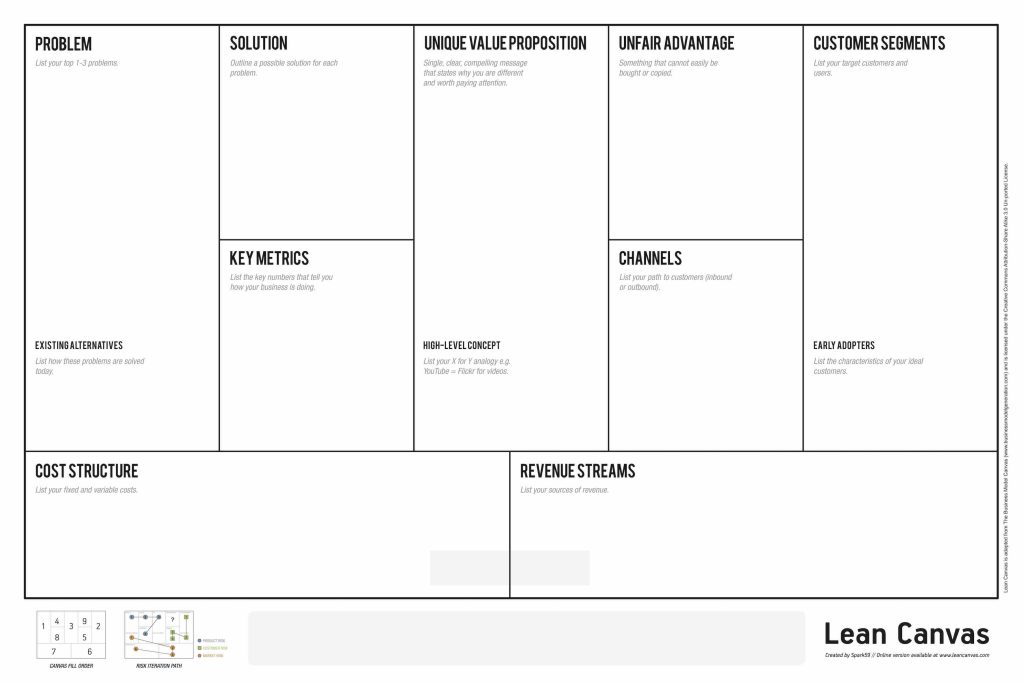
Key Elements to Focus On Right Now:
- Problem & Existing Alternatives: What is the actual pain point? Remember to identify indirect competition. (For example, the indirect competition for a Segway wasn’t a scooter, it was walking!)
- Customer Segments: Geographics, demographics, behaviors. Be hyper-specific.
- Unique Value Proposition (UVP): Why this? Why now? Why you?
- Unfair Advantage: What do you have that cannot be easily bought or copied? (e.g., A proprietary technology, a niche skill, or a exclusive partner pipeline).
- Key Metrics: What belongs on your business “dashboard”? If you don’t measure it, you can’t manage it. Make sure you measure metrics that actually represent long-term value (like repeat customers or retention) rather than just vanity metrics.
Pro-Tip: Use Sticky Notes! Don’t write directly on the paper with a pen. Using sticky notes gives you explicit permission to change your mind. If an assumption proves wrong tomorrow, peel the note off and stick a new one down. Iteration is the goal!
3. “Pretotyping”: Test It Before You Build It
In his book The Right It, author Alberto Savoia makes a crucial distinction between a prototype and a pretotype:
- A Prototype asks: “Can we build it?”
- A Pretotype asks: “If we build it, will people actually buy/use it?”
You do not need to build a full product, buy expensive inventory, or sign a 5-year lease to test a business idea.
- Opening a bookstore? Set up a landing page saying “Bookstore Coming Soon! Register Here for Updates” and see how many people show interest before buying inventory.
- Building an app? Create a 15-minute clickable visual mock-up on your phone without writing a single line of code, and put it in front of a potential user.
The Second-Day Sushi Rule: Savoia’s team tested a concept for discounted “second-day sushi” at Stanford. Instead of launching a business, they bought standard sushi, labeled it “Second-Day Sushi,” placed it in the cafeteria, and watched. Nobody picked it up. They learned the idea was a failure in one afternoon without spending thousands on a facility or inventory.
4. Pass “The Mom Test”
When asking for feedback on your idea, never ask: “I built this new thing, would you buy it?” If you ask your mom, or even friendly acquaintances, they will lie to you because they like you and want to encourage you.
How to Actually Test Your Idea:
- Focus on past behavior, not future promises: Ask them how they currently solve their problem.
- Observe directly whenever possible: What people say or think they do and what they actually do are often completely different.
- Talk to strangers who don’t care about your feelings: You need honest, objective market data, not polite praise.
Key Takeaway
A clear 1-page business plan is infinitely more valuable than a confusing 30-page document. Give yourself permission to be flexible, test your assumptions with cheap pretotypes, and iterate continuously!